
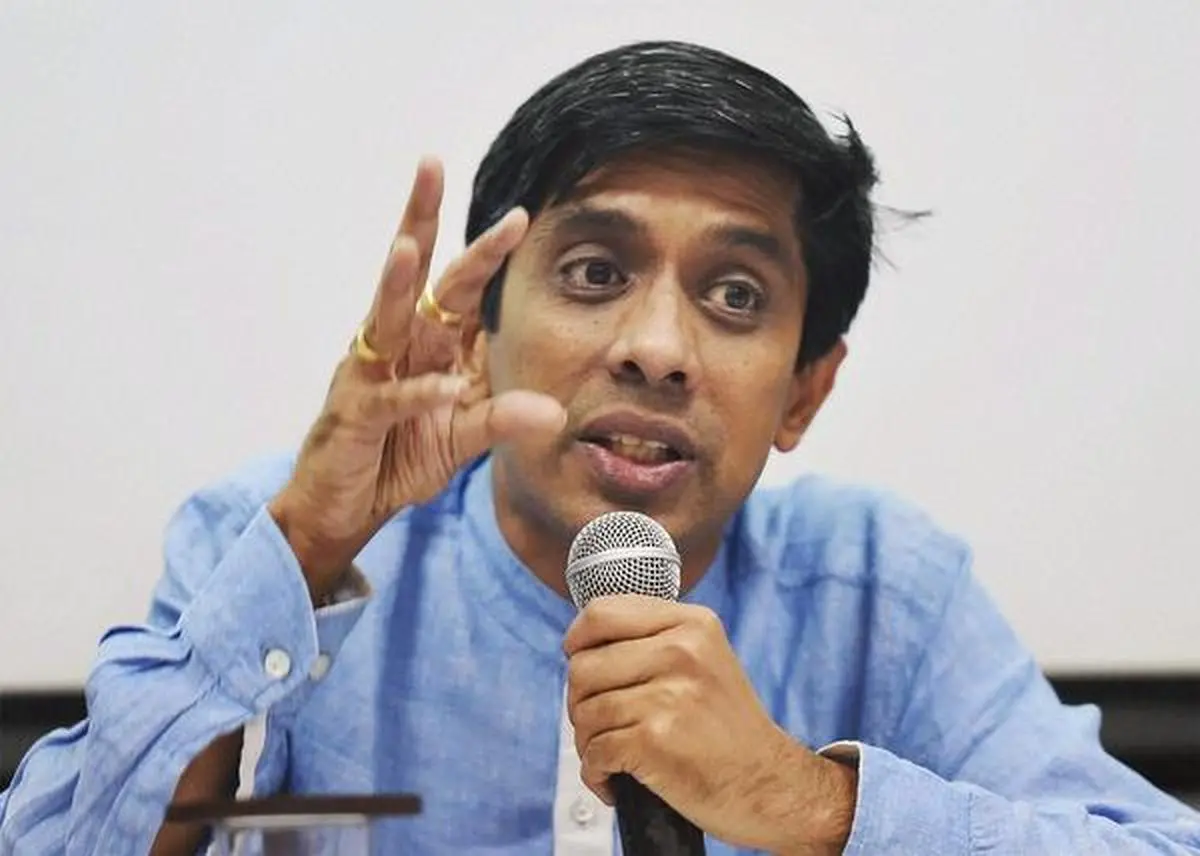
Shashank Joshi is an esteemed journalist and analyst who is recognized for his ability to present complicated international affairs in simple and detailed terms. Through his numerous writings over the years on warfare, geopolitics, military technologies, nuclear strategies, and intelligence among others, Joshi has established a reputable career as a researcher, policy analyst and a top notch journalist who can analyze complicated international affairs and bring out the necessary information. Shashank Joshi has worked at RUSI and The Economist. Joshi has a background in politics, economics and international relations which helps him in his analysis.
What makes Joshi particularly interesting is the route he took into journalism. He did not begin as a conventional newsroom reporter covering daily politics. His background includes advanced university study, academic research, work at major defence and foreign-policy institutions, parliamentary evidence, and published research on subjects ranging from Iran’s nuclear programme to India’s military capabilities.
That mixture of scholarship and journalism has helped Shashank Joshi develop a distinctive professional profile. Rather than discussing geopolitical events only at headline level, he often places them within larger questions about strategy, deterrence, technology, intelligence, diplomacy, and military capability. His career offers an interesting example of how specialist knowledge can move beyond universities and think tanks and become useful to a much wider public audience.
Who Is Shashank Joshi?
Shashank Joshi is a British journalist and international-security specialist whose work has focused heavily on defence, warfare, intelligence, nuclear policy, emerging technology, and geopolitics. He joined The Economist in 2018 and went on to spend eight years as its defence editor. In 2026, The Economist identified him as its Washington bureau chief, marking a significant new stage in his journalistic career.
Before moving into journalism full time, Joshi developed extensive experience as a researcher. He served as a Senior Research Fellow at the Royal United Services Institute, commonly known as RUSI, one of Britain’s best-known institutions for research on defence and international security. He was also a Research Associate with Oxford University’s Changing Character of War Programme. RUSI states that he later joined its Advisory Board in 2020.
His professional interests have always been broad rather than confined to one geographical region. Earlier in his career, his research paid particular attention to South Asia and the Middle East. His later journalism expanded across European security, Russia, Ukraine, China, Taiwan, cyber security, artificial intelligence, intelligence agencies, space security, nuclear weapons and the changing character of modern warfare.
That range helps explain why Shashank Joshi is regularly described as both a journalist and a security expert. He understands academic debates but works in a profession that demands clarity, speed, and relevance. His career therefore sits somewhere between the worlds of strategic studies, public policy, and international journalism.
Shashank Joshi’s Education and Academic Background
Education played a major role in shaping Joshi’s approach to security and international affairs. According to King’s College London, he studied economics and then social and political sciences at Cambridge University. RUSI records from his earlier career state that he graduated from Gonville and Caius College, Cambridge, with a Starred First in politics and economics.
Joshi later continued his education at Harvard University. King’s College London notes that he studied in Harvard’s Department of Government and was a Kennedy Scholar from Britain to the United States. Earlier RUSI biographical material also identified him as a doctoral student in international relations at Harvard and noted that he held master’s degrees from Cambridge and Harvard.
His academic experience was not limited to studying. Joshi also taught politics at Cambridge. His own professional website records that in 2010 he taught first-year politics students at Gonville and Caius College and Selwyn College. He also taught material dealing with the political and sociological dimensions of economics, including subjects such as the international economy and political economy.
This combination of economics, politics, government, and international relations helps explain the analytical style that later became Shashank Joshi in his writing. Military power rarely operates separately from economics or politics. Defence budgets, industrial capacity, alliances, technology, public opinion, and political leadership all affect what armed forces can realistically achieve. An education spanning several of these disciplines gave Joshi a broad framework for analysing security questions.
His Career at RUSI and Work as a Security Researcher
Before becoming widely recognised through The Economist, Shashank Joshi built much of his reputation at the Royal United Services Institute. At RUSI, he worked as a Senior Research Fellow and concentrated heavily on international security. His research covered South Asia and the Middle East, two regions involving some of the most complicated questions of interstate rivalry, nuclear deterrence, terrorism, alliances, and military modernisation.
Working in a policy institute requires a different type of output from conventional journalism. Researchers are expected to examine primary evidence, compare competing explanations, understand policy structures, and develop conclusions that can withstand scrutiny from specialists. Joshi published articles in academic and policy journals while also contributing commentary to newspapers and other outlets. RUSI records show his work appearing across both peer-reviewed publications and mainstream media.
His expertise also brought him into direct contact with policymakers. King’s College London states that Joshi has given evidence to the House of Commons foreign affairs and defence select committees. He has additionally lectured at institutions including the UK Defence Academy and the Atomic Weapons Establishment. RUSI has similarly documented his lectures and parliamentary evidence.
That experience matters because national-security journalism often involves subjects that are technically complicated and politically sensitive. Shashank Joshi covering defence needs to understand not only military equipment or battlefield developments but also institutions, budgets, alliances, doctrine, intelligence, diplomacy, and political objectives. Joshi’s years in research gave him a strong foundation before he moved deeper into journalism.
Shashank Joshi at The Economist
Shashank Joshi joined The Economist in 2018. His appointment brought an established security researcher into one of the world’s most influential international news publications. He eventually became closely associated with the paper’s coverage of defence, security, and military affairs, serving for eight years as defence editor.
His responsibilities covered an unusually large range of subjects. Profiles of his work mention conventional warfare, nuclear weapons, cyber security, intelligence, military technology, space security and geopolitical competition. He also reported directly from locations including Ukraine, Israel and Taiwan while covering some of the major security challenges of the period.
As defence editor, Joshi was responsible for more than traditional written articles. The Economist says he wrote its weekly War Room newsletter, which built an audience of more than 120,000 subscribers. He also presented Inside Defence, a monthly video programme featuring discussions about global defence and intelligence issues.
That combination reflects a broader change in modern journalism. Specialist reporters are no longer limited to writing articles for a printed publication. They increasingly explain complex subjects through newsletters, podcasts, video discussions, live events, and social media. Shashank Joshi role evolved along those lines, allowing him to communicate detailed security analysis to readers who might not normally engage with academic defence literature.
Coverage of War, Military Technology, and Global Security
One of Shashank Joshi’s strongest areas of expertise is the changing nature of warfare. Modern conflicts are increasingly influenced by drones, satellites, digital networks, cyber operations, electronic systems, artificial intelligence, and increasingly sophisticated intelligence capabilities. His work at The Economist has examined how these developments affect military organisations and strategic competition.
RUSI’s 2025 Land Warfare Conference biography noted that Joshi had written about subjects including AI-guided drones, ransomware, cyber attacks, undersea infrastructure, missile proliferation and other emerging security issues. The importance of these subjects goes well beyond individual technologies. They raise larger questions about how governments protect infrastructure, how militaries collect information, and how technological advantages can alter the balance between states.
Joshi has also spent considerable time covering active conflicts. His reporting has dealt with the war in Ukraine and conflicts in the Middle East, while his broader regional work has included security developments involving China, Taiwan and the Indo-Pacific. His background allows him to discuss these events not merely as daily news stories but as examples of longer-term shifts in military doctrine and international power.
An important characteristic of serious defence analysis is recognising the difference between capability and outcome. A country can possess advanced technology without necessarily achieving its political goals. Equally, a smaller force can sometimes create significant strategic problems for a stronger opponent. Much of Shashank Joshi career has been spent examining precisely these relationships between military tools, strategic objectives, political constraints and international competition.
Shashank Joshi’s Work on India and South Asian Security
Long before his work became strongly associated with European and global security, Joshi developed significant expertise in South Asia. India, Pakistan and China present an especially complex strategic environment because all three possess major military capabilities, while India and Pakistan have a history of conflict and India and China continue to manage a difficult strategic relationship.
Joshi wrote extensively on India’s defence policy, nuclear doctrine and military development during his period at RUSI. His publication record includes work on India-Pakistan relations, Indian military doctrine, India-China relations and the evolution of India’s nuclear thinking. His writings appeared in outlets including The Washington Quarterly, Journal of Strategic Studies, Asian Affairs and other specialist publications.
One of his most substantial contributions to this field was his book-length study Indian Power Projection: Ambition, Arms and Influence, published as part of RUSI’s Whitehall Paper series. The work examined India’s growing military capabilities and the ways those capabilities might support the country’s broader ambitions as its economic and geopolitical influence increased.
This area of research remains important because India occupies an increasingly central position in discussions about the Indo-Pacific. Its relationships with China, the United States, Pakistan, Russia and other regional powers place it at the intersection of several major geopolitical trends. Joshi’s earlier research on Indian military power therefore provided useful intellectual groundwork for many of the issues that became even more prominent during his later journalistic career.
Research on Iran and Nuclear Strategy
Iran was another major focus of Shashank Joshi’s early research career. Questions surrounding Iran’s nuclear programme have shaped Middle Eastern diplomacy and security policy for decades, making the subject one of the most complicated challenges facing policymakers in the region.
In 2012, Joshi published The Permanent Crisis: Iran’s Nuclear Trajectory in RUSI’s Whitehall Paper series. The study examined Iran’s nuclear programme, possible future trajectories, the international response, and wider implications for regional security and nuclear non-proliferation.
He continued writing about Iran afterward, including analysis of policy thresholds and international efforts to manage the nuclear dispute. His research was part of a wider body of work on deterrence and nuclear strategy, subjects that require analysts to consider military capability alongside diplomacy, political signalling, risk and miscalculation.
What makes this research relevant to his later journalism is that nuclear issues rarely disappear completely from international affairs. Relations involving Iran, Russia, China, Shashank Joshi , Pakistan, North Korea and established nuclear powers continue to raise questions about deterrence, escalation and arms control. Joshi entered journalism with years of experience analysing precisely those kinds of problems.
Books and Major Publications by Shashank Joshi
Shashank Joshi’s published work demonstrates the academic foundation behind his later journalism. His two best-known longer studies focus on very different countries but share a common interest in how states develop and use national power.
The Permanent Crisis: Iran’s Nuclear Trajectory was published through the RUSI Whitehall Paper series in 2012. It examined Iran’s nuclear development and its broader consequences for international security. RUSI describes the study as looking at potential ways out of the Iranian nuclear crisis while considering what the consequences of a nuclear-armed Iran could mean for the region.
His later work, Indian Power Projection: Ambition, Arms and Influence, examined the growth of India’s military capabilities and the strategic purposes they might serve. The study considered India in the context of its changing international position and increasing military ambitions. Taylor & Francis and RUSI records identify the work as part of the Whitehall Paper series.
Beyond those books, Joshi has produced a substantial catalogue of shorter research. His professional writing list includes analysis of Shashank Joshi nuclear doctrine, India-China relations, Pakistan’s nuclear strategy, Afghanistan, Britain’s involvement in Afghanistan and regional security in the Middle East. The range shows how his work gradually developed from regional expertise into a wider examination of the global security system.
His Approach to Defence and Geopolitical Journalism
One reason Shashank Joshi has attracted a substantial audience is that he writes about subjects that can easily become overloaded with jargon. Military affairs involve specialised terminology, technical systems and complicated organisational structures. Good defence journalism has to preserve accuracy without making every article feel like a professional military handbook.
Joshi’s research background helps with that balance. His academic work required detailed engagement with strategic concepts, while journalism requires those ideas to be communicated efficiently. The transition from RUSI to The Economist therefore made sense: the analytical framework remained, but the audience became broader.
Another noticeable feature of his work is its emphasis on evidence. Serious military analysis can become distorted when commentators focus only on dramatic events or political narratives. Understanding a conflict often requires examining logistics, industrial capacity, technology, geography, alliances, intelligence and economic constraints alongside battlefield developments.
His work also reflects the growing overlap between civilian technology and national security. Cyber networks, artificial intelligence, satellites, telecommunications systems and commercial technology companies now influence military competition in ways that were much less visible a generation Shashank Joshi . RUSI’s description of his journalism highlights precisely this mixture of conventional security issues and newer technological questions.
Shashank Joshi as a Public Commentator and Security Expert
Beyond his published journalism, Shashank Joshi has become a regular contributor to wider public discussions about international affairs. His professional biographies note appearances in broadcast media and participation in conferences and specialist events. His background makes him particularly useful when a news story requires explanation rather than simply a summary of what happened.
His work with government and policy institutions adds another dimension. Giving evidence to parliamentary committees requires analysts to explain complex issues clearly while responding to detailed questions from legislators. King’s College London and RUSI both record his involvement with UK parliamentary committees concerned with foreign affairs and defence.
At the same time, Joshi has maintained links with academic institutions. King’s College London identifies him as a visiting senior fellow in its Department of War Studies, while RUSI lists him as a member of its Advisory Board. These affiliations allow him to remain connected to specialist research even while working in fast-moving journalism.
That connection between several professional worlds is arguably the defining feature of his career. Joshi has worked with academic research, policy institutions, parliamentary Shashank Joshi , journalism and public communication. Each demands a slightly different skill set, yet all revolve around understanding international security.
From Defence Editor to Washington Bureau Chief
A major change in Shashank Joshi’s career arrived in 2026. The Economist’s current media directory identifies him as its Washington bureau chief, rather than defence editor. The publication notes that he held the defence role for eight years before moving into the Washington position.
The shift significantly expands the potential scope of his work. A Washington bureau chief must follow not just military affairs but the wider machinery of American politics and policy. The United States remains deeply influential in international security, global economics, diplomacy, technology and alliance structures, making Washington one of the most important reporting posts at an international publication.
For Joshi, however, the move does not represent a complete departure from his previous expertise. American domestic politics and international security constantly overlap. Decisions made in Washington affect NATO, European security, China policy, the Middle East, defence spending, military technology, intelligence relationships and global alliances.
In that sense, his earlier career appears well suited to the role. Years spent analysing military power provide useful context for understanding American foreign policy, while his academic training in politics and economics offers a wider foundation for covering Washington itself. The move from defence Shashank Joshi to bureau chief therefore looks less like a change of direction and more like an expansion of an already broad professional portfolio.
Why Shashank Joshi’s Work Matters
International-security reporting has become increasingly important because many of the boundaries that once separated military affairs from everyday life are disappearing. Cyber attacks can affect businesses and public infrastructure. Satellite systems support communications and navigation. Artificial intelligence influences both civilian industries and national security. Supply chains determine whether countries can manufacture critical technologies at scale.
At the same time, geopolitical rivalry has returned to the centre of international politics. Competition between major powers, the war in Ukraine, tensions in the Indo-Pacific and repeated crises in the Middle East have made defence policy relevant to audiences far beyond military specialists. Joshi’s journalism sits directly within this changing information environment.
His career also illustrates the value of subject-matter expertise in journalism. Reporters covering highly technical areas need enough background to separate meaningful developments from noise. A long period studying international relations and defence does not guarantee perfect predictions, of course, but it can provide a stronger framework for asking the right questions.
That may be the biggest reason his work has gained attention. Readers are not simply looking for descriptions of events. They want explanations of why those events matter, how Shashank Joshi connect to previous developments and what constraints governments face when responding. Joshi’s combination of research experience and journalistic communication is particularly suited to that demand.
The Continuing Career and Influence of Shashank Joshi
Shashank Joshi’s professional journey has moved through several distinct stages. He began with intensive academic study, developed specialist expertise through institutions such as RUSI and Oxford’s Changing Character of War Programme, and then brought that experience into international journalism at The Economist.
His years as defence editor coincided with an exceptionally consequential period for global security. His reporting covered military technological change, major geopolitical rivalries and wars that reshaped security debates across Europe, Asia and the Middle East. During that period, he also expanded into newsletters and video journalism, building an audience beyond readers of traditional magazine articles.
Now, as The Economist’s Washington bureau chief, Joshi enters another phase of his career. His portfolio may be broader, but the analytical habits developed through years of studying international security are likely to remain central to his reporting.
What makes his career worth following is not merely the titles he has held. It is the way those roles connect. Academic research taught him to investigate problems deeply. Think-tank work brought that research closer to policymaking. Journalism required him to communicate complex conclusions clearly. Together, those experiences have shaped a professional identity that sits comfortably between specialist expertise and public explanation.
Conclusion
To conclude, Shashank Joshi has managed to establish an excellent career for himself through a combination of academic knowledge, strategic insights and effective journalism. In matters pertaining to defence, geopolitics, military technology, nuclear strategy, and international security, Joshi has established himself as an influential figure for those who wish to gain insight into these topics. With his research experience in renowned organizations and senior editorship at The Economist, Joshi has been able to prove that he can articulate the most complex of issues in a practical manner. Given the constantly evolving nature of global security threats, his analysis will continue to be highly relevant.
His research on Iran’s nuclear programme and India’s military development established him as a serious security analyst before his move into mainstream journalism. At The Economist, that expertise expanded into coverage of warfare, technology, intelligence, cyber security and global geopolitical competition. His Shashank Joshi years as defence editor also included the War Room newsletter and the Inside Defence video programme.
The latest chapter is his appointment as Washington bureau chief of The Economist. It places him in a role where domestic politics, foreign policy, economics and global security meet on a daily basis.