
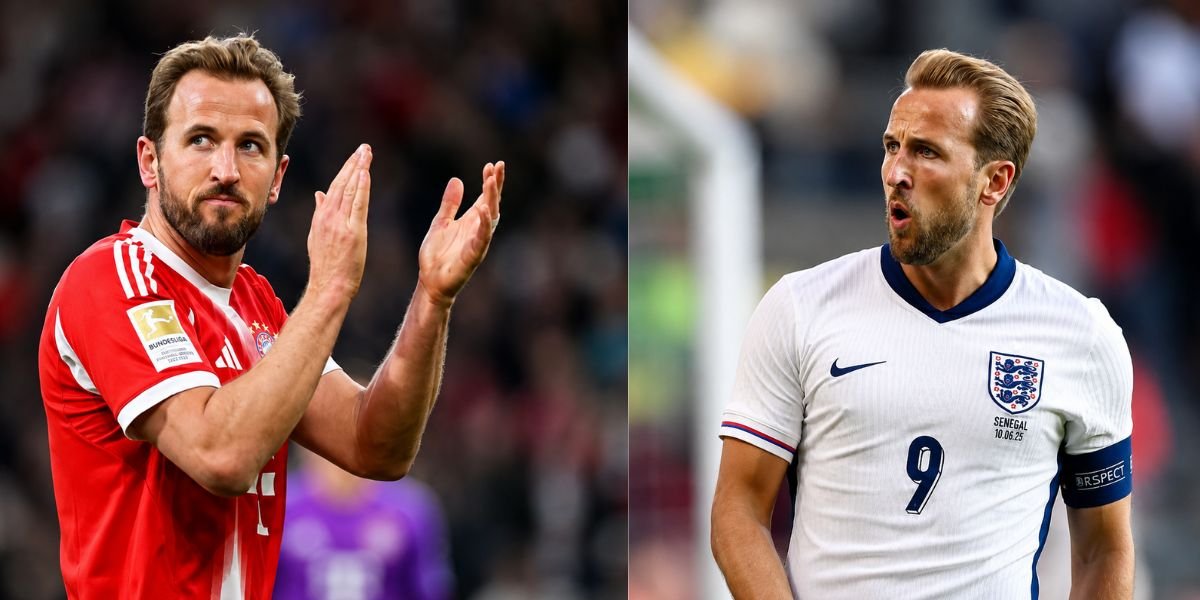
Harry Kane is one of the most accomplished footballers of his generation. Known for his intelligent movement, clinical finishing and calm leadership, the English striker has spent years proving that he is much more than a traditional number nine. He can score from almost anywhere, create opportunities for teammates and influence matches even when he is not receiving regular service inside the penalty area.
Born in London on 28 July 1993, Kane developed through Tottenham Hotspur’s academy before becoming the club’s leading goalscorer. He later moved to Bayern Munich in 2023, accepting the difficult challenge of leaving English football and adapting to a new country, league and tactical environment. Rather than slowing him down, the move allowed him to demonstrate how complete and adaptable his game had become.
Kane is also England’s captain and record goalscorer. His international career has included major tournament finals, individual scoring awards and some of the most important goals in England’s recent history. His story is not simply about statistics, though. It is about patience, improvement and the determination to succeed after being underestimated early in his career.
Harry Kane’s Early Life and Difficult Path to Professional Football
Harry Edward Harry Kane grew up in the London area and began playing football at a young age. Like many talented children, he dreamed of becoming a professional, but his development was not always straightforward. He spent time within youth systems connected to Arsenal and Watford before eventually joining Tottenham Hotspur’s academy. At that stage, few people could have predicted that he would become one of the greatest goalscorers in English football history.
Kane was not initially viewed as an extraordinary physical talent. He did not possess explosive speed, flashy dribbling skills or the kind of athleticism that immediately attracts attention at academy level. Some coaches questioned whether he had the qualities needed to succeed at the highest level. Instead of allowing those doubts to discourage him, Kane concentrated on improving the details of his game, including his positioning, shooting technique, fitness and decision-making.
His early senior career included loan spells at Leyton Orient, Millwall, Norwich City and Leicester City. These experiences were not always glamorous, but they exposed him to different playing styles and competitive environments. He had to deal with physical defenders, limited playing time and the pressure of proving himself. Those loan periods helped him develop the resilience that later became one of the defining qualities of his career.
Harry Kane progress is a useful reminder that football development is rarely a perfect journey. Some players become stars as teenagers, while others need additional time to understand their strengths. Kane belonged to the second group. His rise was based on repetition, patience and a willingness to learn rather than instant fame.
The Breakthrough That Changed Tottenham Hotspur

Harry Kane major breakthrough at Tottenham arrived during the 2014–15 season. After spending time behind more established forwards, he finally received an extended opportunity in the first team. He quickly responded with goals in domestic and European competitions, forcing the coaching staff to make him a regular starter. His ability to finish chances with either foot made him difficult for defenders to predict.
What made Kane’s breakthrough especially impressive was the confidence with which he handled the attention. Young strikers often experience a productive run before opponents begin studying their movements and weaknesses. Harry Kane continued scoring even after Premier League defenders became familiar with his style. He adjusted his positioning, improved his link-up play and became more comfortable dropping into deeper areas.
Over the following seasons, Kane established himself as Tottenham’s main attacking figure. He won multiple Premier League Golden Boot awards and consistently competed with the best forwards in Europe. By the time he left Tottenham, he had scored 280 goals in 435 appearances for the club, making him Spurs’ all-time leading scorer. He also registered 213 Premier League goals, placing him among the competition’s most productive players.
Harry Kane Tottenham career was not only about individual achievements. He helped the club qualify regularly for European competition and played a central role in its run to the 2019 UEFA Champions League final. Although Tottenham were unable to win the trophy, reaching the final represented one of the most important moments in the club’s modern history.
Why Harry Kane Is More Than a Goalscorer
The easiest way to describe Harry Kane is as an elite finisher, but that description does not fully explain his importance. He is capable of scoring powerful long-range efforts, controlled finishes across the goalkeeper, headers and penalties. More importantly, he chooses his shooting positions carefully and rarely appears rushed when an opportunity arrives.
Kane’s passing ability also separates him from many conventional centre-forwards. He frequently moves away from the defensive line, receives the ball between midfield and attack, and plays accurate passes towards runners. This allows quick wingers and attacking midfielders to move beyond him while defenders are forced to decide whether to follow Kane or protect the space behind them.
His awareness is particularly valuable during counterattacks. Kane can receive the ball under pressure, protect it and release a teammate with a well-timed pass. At Tottenham, his connection with Son Heung-min became one of the Premier League’s most effective attacking partnerships. Kane could act as both the scorer and creator, making the pair extremely difficult to control.
He is also tactically disciplined without the ball. Harry Kane understands when to press, when to block passing lanes and when to remain central. He may not chase every defender at maximum speed, but his movements are usually calculated. His intelligence helps his team maintain its structure and forces opponents to play in less comfortable areas.
A New Challenge With Bayern Munich
In August 2023, Harry Kane joined Bayern Munich, ending his long association with Tottenham. The transfer represented a major change in his career. He had to adapt to the Bundesliga, learn the expectations of one of Europe’s biggest clubs and build relationships with a completely new group of teammates. Bayern’s official profile continues to list Kane as a first-team player and highlights his status as England’s captain and record scorer.
Kane adapted to German football remarkably quickly. Bayern’s attacking system gave him opportunities to combine with technically gifted players, but it also demanded that he perform under intense pressure. At Bayern, winning domestic competitions is considered the minimum expectation, while success in the Champions League remains a major objective.
His performances demonstrated that his Premier League success was not dependent on one club or one tactical system. Kane continued to score while also contributing through passing, movement and leadership. The Bundesliga’s official review of his 2025–26 campaign reported 73 goals and eight assists across 65 appearances for Bayern and England between August 2025 and July 2026.
The move also changed the conversation surrounding his career. For years, critics focused on his lack of major team trophies despite his individual records. With Bayern, Harry Kane entered an environment built around competing for silverware every season. Bayern’s official profile now lists Bundesliga titles in 2025 and 2026, as well as the 2026 Franz Beckenbauer Supercup, among his honours.
Harry Kane’s Leadership and England Career
Harry Kane made an immediate impression on his senior England debut in March 2015, scoring shortly after entering the match against Lithuania. He eventually became captain ahead of the 2018 World Cup and led England to the semifinals of that tournament. His six goals earned him the World Cup Golden Boot and confirmed his ability to perform on the international stage.
His leadership style is controlled rather than dramatic. Kane does not usually demand attention through emotional speeches or controversial behaviour. Instead, he leads through preparation, professionalism and consistency. Teammates know that he accepts responsibility during difficult moments, particularly when England need an important goal or penalty.
Kane also helped England reach the finals of UEFA Euro 2020 and Euro 2024. Although England did not win either tournament, reaching consecutive European Championship finals represented significant progress for a national team that had struggled in knockout football for many years. Kane’s experience and composure remained essential throughout those campaigns.
In March 2023, Harry Kane surpassed Wayne Rooney to become England’s all-time leading scorer. England Football describes him as the national team’s captain and record goalscorer, while noting that he has held the captaincy since the 2018 World Cup. His international record has placed him alongside the most important players in England’s football history.
The Mental Strength Behind Kane’s Consistency
Elite footballers are regularly judged by goals, assists and trophies, but consistency also depends on mental strength. Harry Kane has faced injuries, tournament disappointment, transfer speculation and criticism throughout his career. Each time, he has responded by returning to his usual standards rather than allowing outside opinions to control his performances.
His approach to penalties is a clear example of his mentality. Penalty-taking appears simple from a distance, but the pressure can be enormous, especially during knockout matches. Kane relies on preparation and repeated practice. He studies goalkeepers, develops multiple finishing options and attempts to maintain the same routine regardless of the importance of the occasion.
Kane’s decision to leave Tottenham also required courage. Remaining in the Premier League would have been familiar and would have allowed him to continue chasing the competition’s all-time scoring record. Moving to Germany carried risks, including cultural adjustment and greater expectations. His success at Bayern showed that he was prepared to step outside his comfort zone to pursue new challenges.
That professional mindset has helped Kane remain productive into his thirties. He has never depended entirely on speed, which means his game can continue evolving as his physical abilities change. His positioning, passing range and finishing technique should allow him to remain effective even when he is no longer able to cover the same distance during matches.
Harry Kane Place Among the Modern Greats
Comparing players from different teams and eras is always difficult. However, Harry Kane scoring record clearly places him among the leading forwards of modern football. He has produced elite numbers in the Premier League, Bundesliga, Champions League and international tournaments. Very few strikers have maintained that level across so many competitions.
Kane’s style may appear less spectacular than players known for tricks, extreme speed or acrobatic finishes. His brilliance often comes from making complicated decisions look simple. He recognises space before it becomes obvious, positions his body correctly and chooses the right finish with impressive regularity.
His legacy will also be shaped by the balance between individual records and team achievements. The early part of his career was dominated by personal milestones, while his years at Bayern have provided a stronger platform for winning major honours. Continued success in Germany and Europe would strengthen his position in discussions about the greatest strikers of his era.
Regardless of future results, Harry Kane has already changed expectations surrounding the modern centre-forward. He has shown that a striker can lead the line, create chances, organise attacks and captain both club and country. He is not simply waiting inside the penalty area for opportunities. He is often the player responsible for creating the entire attacking sequence.
Conclusion
Harry Harry Kane career is a story of gradual improvement rather than overnight success. He developed from an underestimated academy player into Tottenham Hotspur’s record scorer, England’s leading goalscorer and one of Bayern Munich’s most influential footballers. His journey proves that intelligence, discipline and persistence can be just as important as natural athletic ability.
His greatest strength is his completeness. Harry Kane can finish with either foot, score headers, convert penalties, pass through defensive lines and bring teammates into the game. He understands how to adjust his role depending on the opposition and the players around him. That adaptability has allowed him to succeed in both English and German football.