
What Is Helonium?
Helonium is the common name for the helium hydride ion, written as HeH⁺. In simple words, it is a tiny charged molecule made from helium and hydrogen. More technically, it is a positive ion formed when helium bonds with hydrogen and carries a positive charge. That may sound small, but in chemistry and astronomy, helonium has a surprisingly big story.
The interesting thing about helo nium is that it connects two of the simplest elements in the universe. Helium is famous for being very stable and unreactive, while hydrogen is the lightest and most common element. When these two come together as HeH⁺, they create one of the most important early molecules scientists have studied.
Helonium is not something you can bottle, hold, or use in everyday life. It is extremely reactive and does not survive for long around normal matter. But even though it is difficult to store or observe, it matters because it gives scientists clues about how the first chemical bonds formed after the Big Bang.
Why Helonium Is Called One of the First Molecules
Helonium is often described as one of the first molecules to form in the universe. After the Big Bang, the early universe was extremely hot. As it cooled, simple particles began forming atoms, mainly hydrogen and helium. Later, these atoms and ions started interacting, and one of the earliest important bonds was between helium and hydrogen, forming helium hydride, or helo nium.
This is why helo nium is sometimes called the “first molecule” or the molecule that marks the beginning of cosmic chemistry. Before molecules existed, the universe was mostly a sea of particles and atoms. Once molecules began forming, the universe moved toward more complex chemistry, eventually leading to stars, planets, and the chemical ingredients needed for life.
Of course, helonium did not directly create planets or life by itself. Its importance is more foundational. Think of it like the first tiny step in a very long chain. Without simple early chemistry, the universe could not move toward the more complex chemical systems we see today.
How Helonium Was Discovered
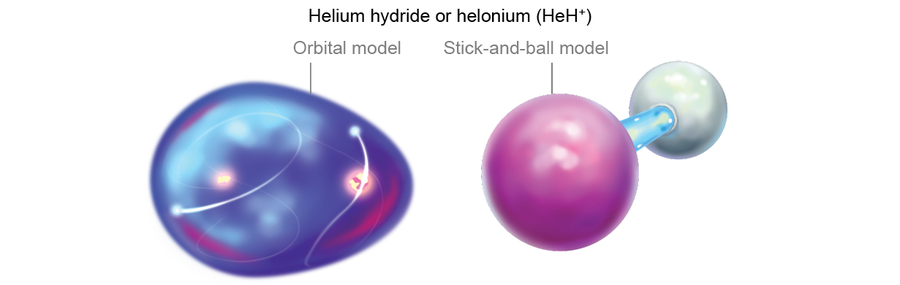
Scientists first produced helium hydride in the laboratory in 1925. Chemists studied mixtures of helium and hydrogen under special conditions and detected the charged molecule HeH⁺. At the time, this was mainly a laboratory discovery, but it later became very important for astronomy and the study of the early universe.
For decades, scientists believed helonium should exist in space, especially in regions that looked similar to early-universe conditions. The problem was that finding it was incredibly difficult. Helo nium has specific signals, but space is full of many other signals, dust, radiation, and chemical noise. Detecting one tiny molecule across thousands of light-years is not exactly easy.
That changed in 2019, when researchers reported the detection of HeH⁺ in the planetary nebula NGC 7027 using the SOFIA airborne observatory. This was a major moment because it gave scientists direct evidence that helium hydride could exist in space, not just in laboratory experiments.
Why Helonium Is So Reactive
Helonium is extremely reactive because it carries a positive charge and strongly wants to interact with other atoms or molecules. In chemistry, charged particles often behave very differently from neutral molecules. Since helo nium is a cation, it can quickly transfer a proton or react with nearby substances.
That is also why scientists cannot simply prepare a jar of helo nium and place it on a lab shelf. It would react with almost anything it touched. In normal conditions, it does not stay stable for practical use. This makes it more of a research molecule than a commercial or industrial material.
Some scientists describe helium hydride as having extremely strong acid-like behavior, especially because it can donate a proton very aggressively. But this point needs careful explanation. Helonium is not an everyday acid like vinegar or battery acid. It is a highly reactive ion studied under special gas-phase or space-like conditions, not a liquid chemical used in normal environments.
Helonium and the Early Universe
Helonium matters because it helps scientists understand how the universe cooled and changed after the Big Bang. In the beginning, there were no stars, no planets, and no familiar chemistry. The universe had to cool enough for atoms and ions to combine. When helium and hydrogen interacted, helonium became part of the first chemical network.
This chemical network helped lead toward the formation of molecular hydrogen, written as H₂. Molecular hydrogen became very important because it allowed gas clouds to cool more efficiently. Cooler gas clouds could collapse under gravity, which helped create the first stars. So, while helonium was not the final product, it helped open the door to later cosmic chemistry.
Modern research continues to study how HeH⁺ reacted in early-universe-like conditions. A 2025 Astronomy & Astrophysics study reported experimental work on reactions between HeH⁺ and deuterium atoms, suggesting some early-universe reaction pathways may have been faster or different than older models assumed.
Where Helonium Exists Today
Helonium is not common in everyday environments, but scientists can find or create it in special places. In laboratories, researchers can produce HeH⁺ under controlled conditions. In space, it may appear in energetic regions where helium, hydrogen, radiation, and charged particles interact.
The famous space detection happened in NGC 7027, a planetary nebula. A planetary nebula forms when a dying star sheds its outer layers, creating a hot cloud of gas. These regions can provide the right mix of energy and chemistry for unusual molecules like helonium to appear.
This does not mean helonium is floating everywhere in large amounts. It is still rare and difficult to detect. But its confirmed presence in space shows that even very simple molecules can teach us big lessons about cosmic history.
Why Scientists Still Study Helonium
Scientists study helonium because it sits at the intersection of chemistry, physics, and astronomy. It is simple in structure but deep in meaning. A molecule made from only helium and hydrogen can help answer questions about how the first stars formed and how the universe moved from simple atoms to complex matter.
Another reason helonium is useful is that it tests scientific models. Researchers build computer models of the early universe, but those models depend on accurate reaction rates and molecular behavior. If helonium reacts differently than expected, scientists may need to update their understanding of early cosmic chemistry.
In this way, helonium is not just an old molecule from the beginning of time. It is still actively shaping modern research. Every new experiment or observation helps scientists refine the story of how the universe became chemically rich.
Common Misunderstandings About Helonium
One common misunderstanding is that helonium is the same as helium. It is not. Helium is a neutral chemical element, while helonium is a charged molecular ion made from helium and hydrogen. They are related, but they behave very differently.
Another misunderstanding is that helonium is a normal stable compound. In reality, it is highly reactive and cannot be stored like water, salt, or oxygen gas. Its chemistry is mostly studied in controlled laboratory environments or through astronomical observations.
Some people also assume that because helonium is called the first molecule, it must still be everywhere today. That is not true. It may have been very important in early-universe chemistry, but today it is rare and usually appears only under special conditions.
Final Thoughts on Helonium
Helonium may be tiny, but its story is huge. It connects the simplest elements, the earliest chemistry, and the formation of the universe as we know it. A molecule made from helium and hydrogen might not sound exciting at first, but once you understand its role, it becomes one of the most fascinating chemical species in science.
The best way to think about helonium is as a cosmic starting point. It represents one of the first steps from a simple, hot universe toward a place where stars, galaxies, planets, and eventually life could exist. That is a lot of importance for such a small ion.