
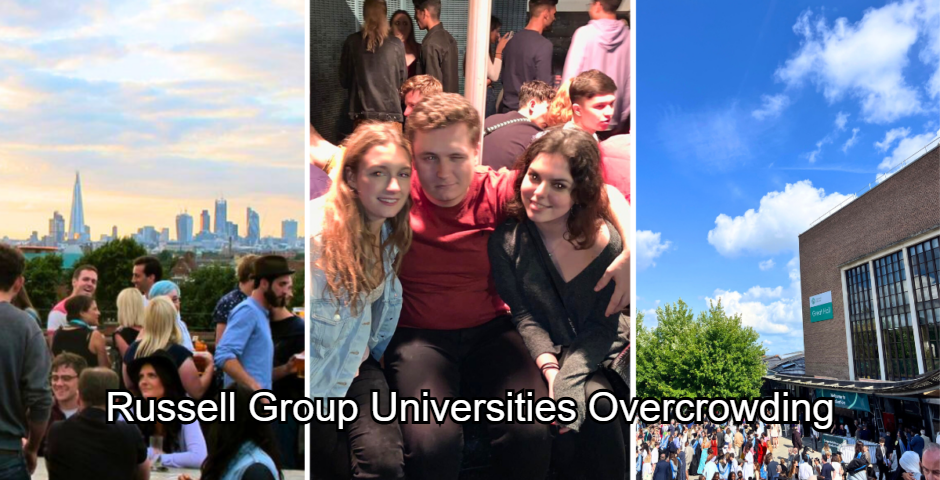
Russell Group universities overcrowding has become a serious talking point among students, parents, and education experts in the UK. These universities are known for world-class teaching, strong research, respected degrees, and competitive admissions, but popularity brings pressure. When more students want access to the same lecture halls, libraries, accommodation, labs, and support services, the student experience can start to feel stretched.
The Russell Group is made up of 24 research-intensive UK universities, including institutions such as Oxford, Cambridge, Imperial College London, UCL, Manchester, Edinburgh, Leeds, Bristol, Glasgow, and others. These universities attract large numbers of home and international students because their degrees carry strong academic and career value.
However, overcrowding is not only about “too many students.” It is also about whether university infrastructure, teaching staff, housing supply, mental health services, and campus facilities are growing at the same pace as student demand. In many cases, the pressure is real, but the causes are more complex than they first appear.
What Does Russell Group Universities Overcrowding Mean at Russell Group Universities?
Russell Group Universities Overcrowding at Russell Group universities usually means students feel there are not enough physical or academic resources for the number of people enrolled. This can show up in packed lecture theatres, limited seminar spaces, long library queues, crowded study areas, oversubscribed modules, and difficulty booking academic support. For students paying high tuition fees, this can feel frustrating because they expect a premium learning experience.
It can also mean pressure outside the classroom. Russell Group Universities Overcrowding accommodation is one of the biggest issues in many university cities. When university halls and private rentals cannot meet demand, students may face high rents, longer commutes, or last-minute housing stress. HEPI reported that only 8,692 new purpose-built student accommodation bed spaces became available in summer 2024, describing it as the lowest level this century.
Still, overcrowding is not the same at every Russell Group university. Some campuses have better space planning, stronger college systems, more flexible teaching models, or larger estates. Others are located in dense cities where expansion is harder. So, the problem is not simply “Russell Group bad” or “students too many.” It is a capacity planning issue across teaching, housing, funding, and student support.
Why Are Russell Group Universities Overcrowding Universities Becoming So Crowded?

One major reason is demand. Russell Group Universities Overcrowding universities are seen as high-status institutions, and many students believe these degrees improve career chances. This means applications remain strong, especially for subjects like medicine, law, engineering, computer science, economics, business, and life sciences. When a university is highly ranked and well-known, it naturally attracts more applicants than it can comfortably support.
Another reason is financial pressure. UK universities have faced rising costs, inflation, and funding challenges. In England, undergraduate tuition fees increased from £9,250 to £9,535 in 2025/26, the first rise since 2017, but this still followed years of financial pressure on providers. Because of this, universities often rely on student recruitment to protect income, especially when research, estates, staffing, and student services are expensive to maintain.
International student recruitment also plays a role, but it should not be explained in a simplistic way. International students bring major academic, cultural, and financial value to UK universities. The Russell Group says around 247,000 international students study at its research-intensive universities, representing over a third of all international students in the UK. The real issue is not international students themselves; it is whether universities and cities have enough classrooms, housing, staff, and services to support total student growth properly.
How Russell Group Universities Overcrowding Affects Students
The first impact is Russell Group Universities Overcrowding experience. When lectures are too full, students may feel like they are watching content rather than participating in learning. Large classes can make it harder to ask questions, build relationships with lecturers, or receive detailed feedback. For courses that depend on labs, studios, clinics, or practical training, overcrowding can be even more noticeable because physical space and equipment are limited.
The second impact is wellbeing. A crowded campus can make university feel impersonal, especially for first-year students trying to settle in. If accommodation is expensive or far from campus, students may feel isolated, tired, or disconnected from university life. Long commutes, noisy halls, and limited quiet study space can add stress during exams and assignment periods.
The third impact is fairness. Students at crowded universities may pay similar fees but receive very different day-to-day experiences depending on their course, campus, and department. A student in a small tutorial-based course may feel well supported, while another student in a high-demand subject may struggle to access staff time. That gap can affect satisfaction, confidence, and even academic performance.
Are International Students Causing the Problem?
It is easy for people to blame Russell Group Universities Overcrowding students, but that is not a fair or accurate explanation. International students are part of the UK university system, and they help fund teaching, research, facilities, and academic opportunities that also benefit home students. They also bring global perspectives into classrooms, which is especially valuable at research-led universities.
The real problem is planning. If a university recruits more students but does not expand accommodation, teaching staff, seminar rooms, labs, wellbeing services, and digital systems, overcrowding will happen regardless of whether students are domestic or international. In other words, the issue is not who the students are; the issue is whether the institution has enough capacity for the total number of students it accepts.
It is also important to remember that overall UK higher education enrolments are not endlessly rising every year. HESA reported 2,863,180 higher education student enrolments in 2024/25, a 1% decrease from 2023/24. That means overcrowding can happen even when the national total is slightly down, because demand may be concentrated in certain universities, cities, courses, and accommodation markets.
Why Accommodation Is a Major Part of the Overcrowding Debate
For many students, Russell Group Universities Overcrowding is felt most strongly through housing. A student may be accepted into a top university, but then struggle to find affordable accommodation nearby. In cities like London, Manchester, Bristol, Edinburgh, Leeds, and Glasgow, student housing demand often competes with wider rental market pressure. This can push students into expensive rooms, shared houses far from campus, or temporary arrangements.
Accommodation shortages also change the social experience of university. Students who live far away may miss evening events, society meetings, library sessions, or group work. First-year students especially rely on housing to build friendships and feel part of the campus community. When housing is scattered or unaffordable, the “university experience” becomes harder to access.
This is why overcrowding should not only be measured by lecture hall seats. A university could technically fit students into classrooms but still fail them through poor housing availability, weak transport links, or limited study spaces. A good student experience depends on the full ecosystem around campus, not just admissions numbers.
What Can Russell Group Universities Overcrowding Universities Do to Reduce Overcrowding?
Universities need better capacity planning before Russell Group Universities Overcrowding enrolment. That means looking at real teaching space, staff availability, library demand, lab access, accommodation supply, and student support capacity before offering more places. Growth should be matched with investment, not treated as a quick financial solution.
They also need to improve teaching design. Large lectures are not always bad, especially when supported by smaller seminars, tutorials, digital resources, and strong feedback systems. But if students only experience crowded lectures and limited staff contact, quality suffers. Russell Group universities should protect small-group learning wherever possible because that is where students often get the most academic value.
Finally, universities need stronger partnerships with local councils, housing providers, and transport authorities. Student numbers affect whole cities, not just campuses. If a university expands but the city does not have enough housing or transport capacity, students and local residents both feel the Russell Group Universities Overcrowding. Long-term planning should include affordable student accommodation, safe commuting options, and investment in shared community infrastructure.
Final Thoughts
Russell Group universities overcrowding is a real concern, but it is not a simple story of “too many students.” It is the result of high demand, financial pressure, limited housing supply, concentrated applications, and infrastructure that sometimes grows slower than enrolment. These universities remain some of the strongest academic institutions in the UK, but prestige alone does not guarantee a smooth student experience.
For students, the best approach is to research beyond rankings. Look at student-to-staff ratios, accommodation availability, course structure, campus space, student Russell Group Universities Overcrowding , and support services before choosing a university. A famous name matters, but day-to-day learning conditions matter too.